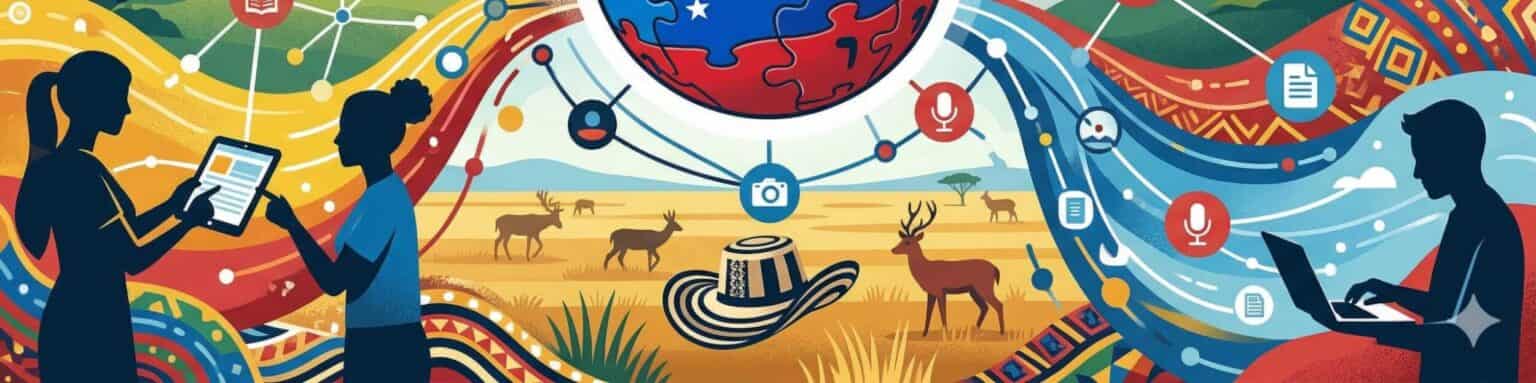
The Future of Media Archives is defined by the convergence of three powerful forces: Artificial Intelligence (AI), Open Data, and advanced Digital Preservation. By late 2025, these fields are no longer separate disciplines but an interconnected ecosystem where archives are transitioning from static repositories to dynamic, “living” nodes in a global knowledge graph.
1. AI in the Archive: From Automation to Regeneration
Artificial Intelligence has moved beyond simple automation to become a core component of archival strategy, fundamentally changing how media is processed, restored, and accessed.
- Automated Preservation & Restoration:
- Defect Detection: AI models are now standard for inspecting vast quantities of digitized footage. Instead of manual spot-checks, algorithms scan entire collections to identify “anomalies” such as film grain defects, audio dropouts, or color fading.
- Generative Restoration: Advanced models can now “inpaint” missing visual data or reconstruct damaged audio frequencies with high fidelity. However, this raises ethical questions about authenticity—archives must now distinguish between “original” defects and “AI-repaired” versions.
- Semantic Metadata Generation:
- Deep Content Understanding: AI is unlocking “deep archives” by automatically generating time-coded metadata. This includes speech-to-text transcription, facial recognition (identifying public figures in hours of b-roll), and object detection.
- Bias Detection: Tools like the DE-BIAS project allow archives to scan millions of catalog entries to identify and contextualize outdated or offensive language, ensuring that historical descriptions meet modern ethical standards without erasing the original record.
- Generative AI & Synthetic Media:
- Archives are increasingly used as training datasets for Generative AI (GenAI). While this offers revenue streams (licensing footage to train video generation models), it threatens the “trust” capital of archives. A major challenge for 2025 is developing detection tools to spot synthetic content before it enters the historical record.
2. Open Data: The Archive as a Knowledge Graph
The “siloed” archive is obsolete. The future lies in Linked Open Data (LOD), where archival records are not just searchable text but interconnected entities on the Semantic Web.
- From Strings to Things:
- Archives are shifting from text-based catalogs to Knowledge Graphs. Instead of a flat record saying “Directed by Alfred Hitchcock,” the entry is a linked entity connecting to every other movie, location, and actor associated with Hitchcock across the web.
- WorldCat Entities and Europeana are leading this charge. In 2025, OCLC reported adding over 400 million entity URIs to bibliographic records, effectively turning library catalogs into a massive, machine-readable web of data.
- Open Access as Preservation:
- Institutions like the British Film Institute (BFI) and Europeana champion “Open” policies (e.g., CC0 licenses). By making metadata and lower-resolution proxies freely available, they ensure redundancy. If a central server fails, the distributed knowledge remains alive in the global network.
- This openness also enables “computational archival science,” where researchers can download entire datasets (e.g., all 19th-century newspaper headlines) to analyze macro-historical trends rather than reading individual documents.
3. Digital Preservation 2.0: Beyond the Hard Drive
As data volumes explode (predicted to reach 175 zettabytes by 2025), traditional storage (tape/HDD) is becoming unsustainable. Two major technologies are emerging to solve the “bit rot” crisis.
- DNA Data Storage:
- Biology is becoming the ultimate storage medium. DNA is incredibly dense (1 exabyte per mm³) and durable (lasting 500+ years). By late 2025, DNA storage has moved from science fiction to a “practical impact” phase for specific niches like cold storage of biological data, with a roadmap for broader archival adoption by 2030. Microsoft and University of Washington are key players in this space.
- Decentralized Storage (Web3):
- Protocols like IPFS (InterPlanetary File System) and Arweave offer “permanent” storage by distributing data across a global network of nodes.
- Arweave calls this the “permaweb”—a ledger of history that cannot be altered or deleted by a single entity. This is particularly vital for “at-risk” archives (e.g., political dissidents or war crimes documentation) where a centralized server could be targeted or censored.
4. The Great Conflict: Copyright vs. The Machine
The intersection of Open Data and AI has created a legal minefield.
- The Training Data Dilemma: AI models devour “open” data to learn. While archives want to be open for human researchers, many are hesitant to let tech giants scrape their collections for free to build commercial products.
- The “Opt-Out” Battle: The EU AI Act (fully applicable by mid-2025) and copyright directives now include “opt-out” mechanisms for text and data mining (TDM). However, standardization is a mess—there is no universal “do not train” flag that all AI scrapers respect, leaving archives in a defensive posture.
- Case Study: The BBC has faced backlash for restricting manual access to its Written Archives Centre in favor of “organized content releases.” Critics argue this curation limits independent research, highlighting the tension between “managed” digitization and true open access.
Summary Table: The Evolution of Media Archives
| Feature | Traditional Archive (Past) | Future Archive (2025+) |
|---|---|---|
| Cataloging | Manual entry, text-based | AI-generated semantic metadata, Linked Data |
| Storage | Physical tape, local servers | DNA storage (emerging), Decentralized (Arweave/IPFS) |
| Access | On-site, request-based | API-first, Knowledge Graph nodes, Open Datasets |
| Restoration | Manual frame-by-frame repair | AI “inpainting” and automated defect detection |
| Primary Risk | Physical degradation, fire | Bit rot, Deepfakes, Copyright exploitation by AI |
The Bottom Line: The future archive is not a warehouse of boxes, but a computational engine. It uses AI to describe itself, Open Data to connect itself, and novel biology or decentralized networks to preserve itself for the next millennium.