Before the internet, encyclopedias were the crown jewels of academic households — heavy, expensive, multi-volume sets that represented the organized sum of human knowledge. Families saved for years to purchase a Britannica set; school libraries guarded their encyclopedia shelves like sacred archives. Today, those printed volumes have been largely replaced by something far more powerful, far more current, and completely free: online encyclopedias. From Wikipedia to Britannica Online, from subject-specific wikis to national digital encyclopedias, these platforms have fundamentally transformed how students, teachers, and self-directed learners engage with knowledge. Understanding their role in modern education means understanding one of the most significant shifts in how humanity organizes, shares, and builds upon what it knows.
From Print to Pixel: A Knowledge Revolution
The transition from print to digital encyclopedias is not simply a change in format — it is a revolution in the nature of encyclopedic knowledge itself. Printed encyclopedias were static: once published, their contents were frozen until the next edition, which might arrive a decade later. They were also prohibitively expensive, physically bulky, and geographically constrained to the homes and institutions that could afford and store them.
Online encyclopedias shattered each of these limitations simultaneously. They are dynamic — updated continuously as new information emerges, new research is published, and world events unfold. They are free or low-cost, accessible to anyone with an internet connection. They are boundless in scope, covering not just the topics that a print publisher deemed commercially viable but virtually every subject that a community of contributors finds worth documenting.
Wikipedia, launched in 2001, exemplifies this transformation most dramatically. From a modest experiment in collaborative online editing, it has grown into the world’s largest encyclopedia — containing over 61 million articles across more than 300 languages, with English Wikipedia alone exceeding 6.7 million articles. It receives approximately 1.7 billion unique visitors per month, making it one of the most visited websites on Earth and, by virtually any measure, the most widely consulted reference work in human history.
Wikipedia: Democratizing Knowledge at Scale
No discussion of online encyclopedias in modern education is complete without a deep engagement with Wikipedia — both its extraordinary achievements and its legitimate limitations. For most students worldwide, Wikipedia is the default starting point for any research inquiry, a fact that has generated decades of debate among educators, librarians, and academics.
Wikipedia’s model is genuinely revolutionary: a collaboratively written, openly licensed encyclopedia that anyone can edit, in any language, at any time. This crowdsourced approach has produced a resource of remarkable breadth and, in many domains, surprising depth and accuracy. A landmark study published in the journal Nature in 2005 found that Wikipedia’s accuracy in scientific articles was comparable to that of Encyclopaedia Britannica — a finding that shocked many in the academic establishment and forced a reassessment of dismissive attitudes toward collaborative knowledge creation.
The educational value of Wikipedia extends beyond its content. The platform’s transparent edit histories allow students to trace how an article evolved over time, who made which changes, and what debates occurred among editors — making it a living case study in how knowledge is constructed, contested, and revised. Its citation requirements model good research practice: every significant claim should be supported by a verifiable source. Its “Talk” pages reveal the intellectual disagreements and editorial decisions behind seemingly authoritative text, teaching students that knowledge is never neutral or inevitable, but always shaped by human choices.
Britannica Online and Curated Digital Encyclopedias
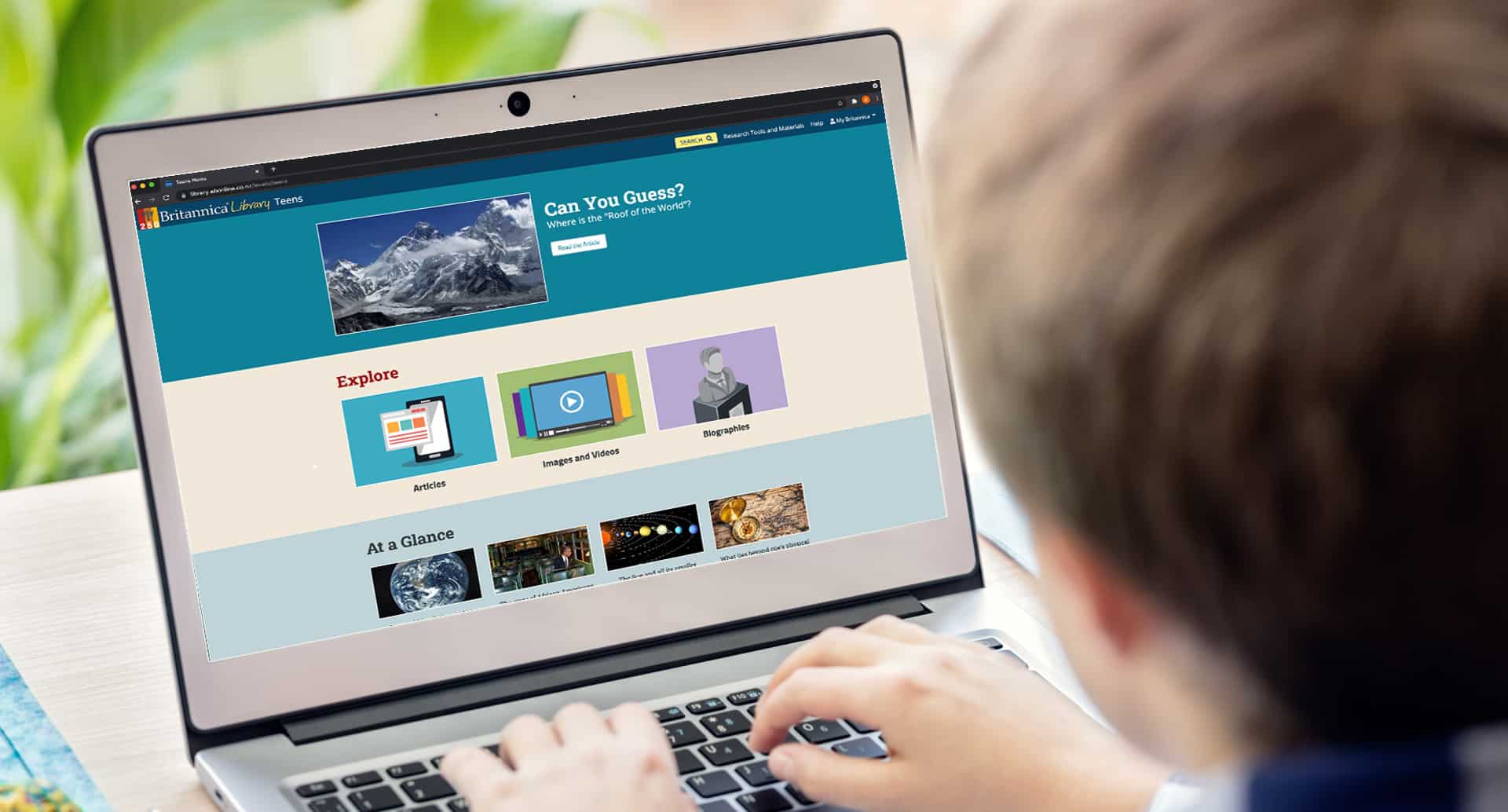
While Wikipedia represents the open, collaborative model of online encyclopedias, platforms like Encyclopaedia Britannica Online represent the curated, expert-authored alternative. Britannica Online maintains the traditional encyclopedia model — articles written by identified subject-matter experts, reviewed by editorial boards, and updated by professional staff — but delivers it through a digital platform accessible via school and library subscriptions.
The educational value of curated encyclopedias lies precisely in their editorial accountability. Every article has a named author with verifiable credentials; every claim has been reviewed for accuracy by domain experts; every update is managed by professional editors rather than anonymous contributors. This makes them particularly valuable for younger students who have not yet developed the critical evaluation skills to navigate Wikipedia’s more complex epistemological landscape.
Many school districts and public library systems provide free student access to Britannica Online, World Book Online, or similar platforms — ensuring that even students without disposable income have access to high-quality, reliably curated reference material. This institutional access model represents an important bridge between the open-access ethos of Wikipedia and the quality-assurance standards of traditional academic publishing.
Subject-Specific and Multilingual Encyclopedias
Beyond general-purpose encyclopedias, the digital age has enabled the creation of thousands of subject-specific online encyclopedias that serve specialized educational communities with a depth and precision that no general encyclopedia could match.
In medicine and health sciences, resources like the Merck Manual Online and MedlinePlus function as encyclopedic references accessible to both healthcare professionals and informed patients. In mathematics, Wolfram MathWorld provides exhaustive coverage of mathematical concepts, theorems, and proofs. In philosophy, the Stanford Encyclopedia of Philosophy (SEP) — a peer-reviewed, openly accessible resource maintained by Stanford University — is widely regarded as the gold standard reference work in its field, used by undergraduate students and professional philosophers alike.
The multilingual dimension of online encyclopedias carries enormous educational significance. Wikipedia’s availability in over 300 languages means that a student in rural Peru can research Incan history in Spanish, a student in rural India can learn about the Mughal Empire in Hindi or Bengali, and a student in Ethiopia can explore African geography in Amharic. This linguistic reach is unprecedented in the history of reference publishing and represents a genuine step toward equitable access to organized knowledge across the world’s linguistic communities.
How Educators Are Integrating Online Encyclopedias
The relationship between online encyclopedias and formal education has evolved considerably over the past two decades. The early 2000s saw widespread blanket prohibitions on Wikipedia citation in academic work — policies driven by legitimate concerns about reliability but often applied without nuance. Today, most educators have developed more sophisticated and pedagogically productive approaches.
Rather than banning Wikipedia, progressive educators are using it as a teaching tool for information literacy. Students are assigned to analyze Wikipedia articles critically: to examine the quality and diversity of citations, to identify gaps or biases in coverage, to compare the article’s claims with other sources, and to investigate the article’s edit history for signs of controversy or vandalism. Some classes go further, assigning students to contribute to Wikipedia — researching and writing new content or improving existing articles as authentic, public-facing academic work.
This approach transforms Wikipedia from a passive shortcut into an active learning environment. Students who must write for Wikipedia — knowing their work will be publicly visible and subject to peer review by the global Wikipedia community — develop research, writing, and citation skills that far exceed what most traditional classroom assignments demand. The Wikipedia Education Program, which has facilitated hundreds of thousands of student article contributions across dozens of countries, demonstrates the platform’s potential as a genuine pedagogical tool rather than simply a research shortcut.
The Misinformation Challenge
Honest assessment of online encyclopedias in education must acknowledge their vulnerabilities. Wikipedia, in particular, is susceptible to vandalism, bias, and systemic gaps in coverage. Studies have documented that Wikipedia covers topics related to Western, English-speaking cultures far more extensively than topics related to the Global South, indigenous communities, or non-Western knowledge systems. Women, people of color, and scholars from developing countries are significantly underrepresented among Wikipedia’s editor community — a demographic imbalance that inevitably shapes which topics receive attention and how they are framed.
Vandalism — the deliberate insertion of false information — is a persistent challenge, though Wikipedia’s automated systems and active editor community typically catch and revert most vandalism within minutes. More insidious are subtle biases, selective emphasis, and the privileging of easily citable mainstream sources over equally valid but less-documented forms of knowledge.
These limitations are not arguments against using online encyclopedias in education — they are arguments for using them critically and in combination with other sources. Educators who teach students to recognize Wikipedia’s structural biases are delivering one of the most valuable critical thinking lessons available, preparing young people to interrogate all information sources — not just online encyclopedias — with healthy intellectual skepticism.
Offline Access and Global Reach
One of the most innovative developments in online encyclopedia distribution has been the creation of offline versions designed for communities without reliable internet access. The Kiwix platform allows users to download entire snapshots of Wikipedia, Wikivoyage, Project Gutenberg, and other open knowledge resources for offline browsing — enabling access in schools, libraries, and community centers in areas where connectivity is limited or expensive.
The RACHEL (Remote Area Community Hotspot for Education and Learning) project pre-loads Wikipedia and other educational resources onto local servers that can serve an entire school via Wi-Fi without any external internet connection. These initiatives ensure that the educational benefits of online encyclopedias are not restricted to the connected world — extending their reach into the most remote and underserved communities on Earth.
This offline accessibility is particularly transformative for education in sub-Saharan Africa, Southeast Asia, and rural Latin America, where school connectivity rates remain low but the hunger for quality educational content is immense. A single RACHEL server in a community school can give hundreds of students their first meaningful access to encyclopedic knowledge — a genuinely life-changing resource deployment at remarkably low cost.
Building Research Skills for the Digital Age
Perhaps the most enduring contribution of online encyclopedias to modern education is their role in shaping how an entire generation understands and practices research. For students who have grown up with Wikipedia as their default reference point, the encyclopedia is not the end of research — it is the beginning. Well-structured Wikipedia articles provide overviews that orient students to a topic, introduce key terminology, identify major scholars and debates, and most valuably, provide bibliographies of primary and secondary sources that can anchor deeper investigation.
Teaching students to use Wikipedia as a research scaffold rather than a research destination is one of the most practical and transferable information literacy skills an educator can impart. It acknowledges how students actually behave — they begin with Wikipedia, as virtually everyone does — while channeling that natural behavior into disciplined research practice.
The Encyclopedia Reimagined
Online encyclopedias have not simply replaced their print predecessors — they have reimagined what an encyclopedia can be. They can be collaborative or curated, generalist or specialist, global or local, static or continuously evolving, text-only or multimedia-rich. They can be written by Nobel laureates or by volunteer enthusiasts, and increasingly, the quality difference between these two models is smaller than traditional gatekeepers would like to admit.
In modern education, online encyclopedias serve simultaneously as reference tools, information literacy laboratories, collaborative writing platforms, and windows onto the contested, constructed nature of knowledge itself. They are imperfect — as all human knowledge systems are imperfect — but they represent one of the most democratizing forces in the history of education.
The student in Lima who opens Wikipedia to begin a history essay, the teacher in Lagos who uses Britannica Online to prepare a science lesson, the self-taught programmer in Jakarta who learns from a subject-specific wiki — all are participants in an ongoing, global experiment in collective intelligence. That experiment, for all its flaws and ongoing challenges, is producing something remarkable: a world in which the organized knowledge of humanity is, for the first time, genuinely available to all of humanity.