
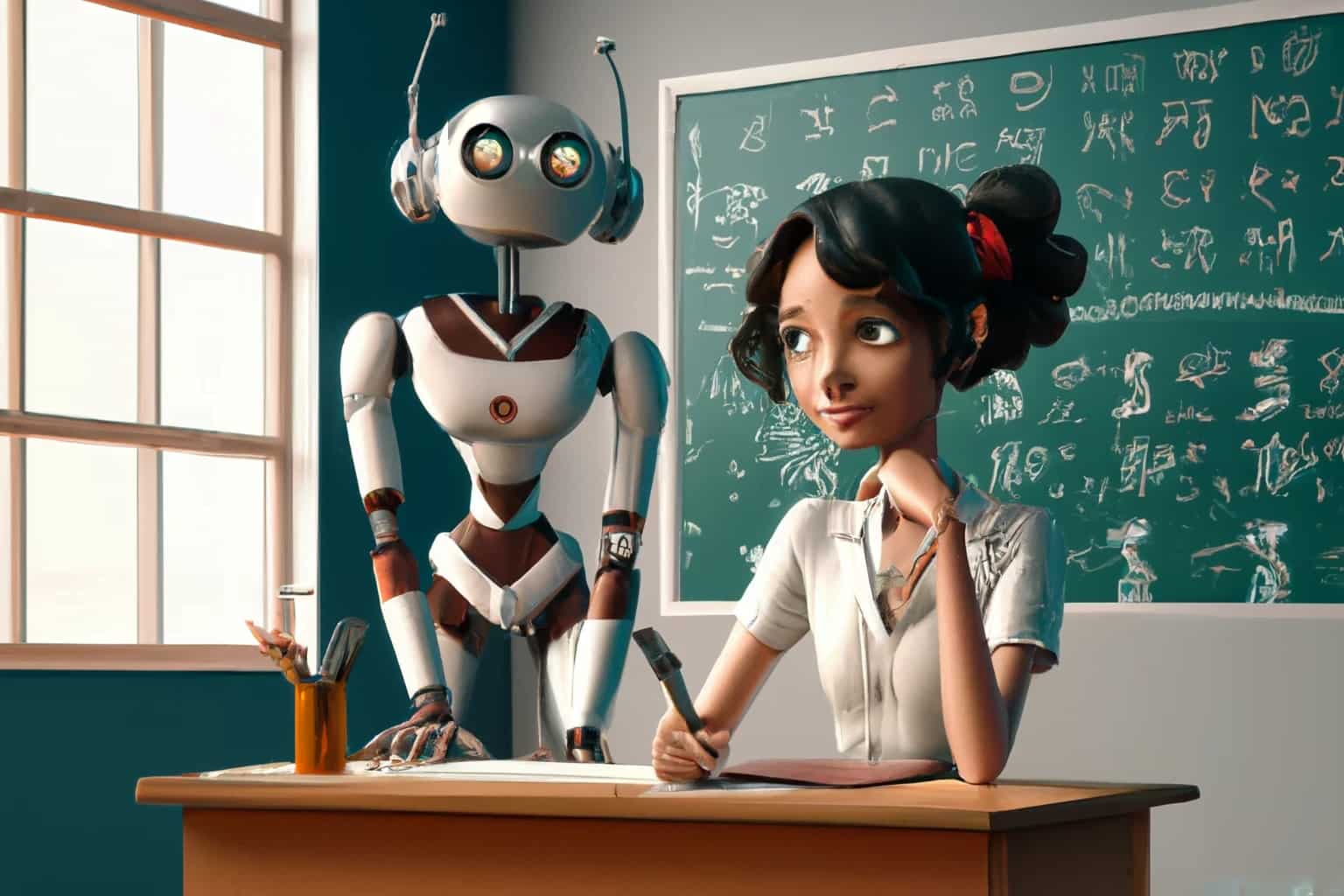
Teaching is one of the most cognitively demanding and emotionally intensive professions in the world. Yet a startling proportion of a teacher’s working hours — research suggests anywhere from 40 to 60 percent — is consumed not by the irreplaceable human work of inspiring, connecting with, and genuinely educating students, but by administrative tasks: grading papers, writing feedback, planning lessons, differentiating materials, tracking progress, drafting reports, and managing the endless logistics of running a classroom. Artificial intelligence is changing this equation in ways that are both practically significant and philosophically important. By automating or substantially accelerating the most routine cognitive labor of teaching, AI is creating the possibility of something educators have long needed but rarely had: time. Time to know their students deeply, to facilitate rich discussion, to provide the mentorship and emotional support that research identifies as the most powerful drivers of student success. AI for teachers is not about replacing educators — it is about liberating them to be more fully and powerfully human in the work that only humans can do.
The Administrative Burden Problem
Before examining what AI can do for teachers, it is essential to understand the scale of the problem it is addressing. The OECD’s Teaching and Learning International Survey (TALIS) consistently documents that teachers in most countries spend fewer than half of their contracted working hours in direct instructional contact with students. The remainder is consumed by grading, planning, administrative reporting, parent communication, and compliance documentation.
In the United States, a study by the Bill & Melinda Gates Foundation found that teachers spend an average of 10.5 hours per week on tasks other than direct instruction — with grading and feedback accounting for the largest single share of that time. In the United Kingdom, teacher workload surveys identify excessive administrative burden as the primary driver of teacher attrition — a finding echoed across the OECD. The global teacher shortage, which UNESCO estimates at 44 million teachers needed worldwide by 2030, is driven significantly by the unsustainable workload conditions that drive qualified educators out of the profession.
AI cannot solve every dimension of this crisis — but it can make a substantial and immediate difference to the workload of every teacher who has access to it. That difference, multiplied across millions of teachers globally, represents an enormous potential improvement in both teacher well-being and student outcomes.
AI-Powered Grading: From Hours to Seconds
Grading is the quintessential teacher task that is both essential and exhausting — requiring careful attention to each student’s work, consistent application of evaluation criteria, and the professional judgment to distinguish genuine understanding from surface compliance. For objective assessment types, AI has essentially solved the grading problem: multiple-choice, true/false, fill-in-the-blank, and numerical answer questions can be graded automatically with perfect consistency at any scale, a capability that learning management systems have offered for years.
The more significant recent development is the advance of AI into subjective assessment — evaluating the quality of written work, mathematical reasoning processes, and complex open-ended responses that previously required human professional judgment to assess. Natural language processing systems can now evaluate essays and extended written responses with impressive sophistication, assessing argument structure, evidence use, logical coherence, vocabulary range, grammatical accuracy, and adherence to assignment-specific rubrics — producing evaluation reports that closely align with human expert scores across multiple independent studies.
Platforms like Turnitin’s AI feedback tools, Gradescope, and EssayGrader allow teachers to upload assignment rubrics and receive AI-generated evaluations of student submissions that they can review, adjust, and approve — transforming grading from a solitary multi-hour process into a streamlined review-and-confirmation workflow. For a teacher managing 120 student essays, the difference between spending 8 hours grading and spending 90 minutes reviewing AI-generated evaluations is the difference between professional sustainability and burnout.
In STEM subjects, AI grading tools are advancing beyond text evaluation into the assessment of mathematical problem-solving processes, programming code, and scientific reasoning. Gradescope’s AI-assisted grading for mathematics and engineering courses uses computer vision and NLP to interpret handwritten work, group similar responses for batch feedback, and identify systematic errors across the class — capabilities that dramatically reduce grading time while generating richer diagnostic data than traditional manual grading produces.
The critical pedagogical principle governing AI grading implementation is that AI evaluates, humans decide. AI grading tools are most valuable as a first-pass assessment that surfaces patterns, generates initial scores, and drafts feedback for teacher review — not as autonomous evaluators whose outputs are delivered to students without human oversight. Teachers who review and personalize AI-generated evaluations before returning them to students maintain the professional judgment and relationship accountability that grading requires while recapturing hours of processing time.
Personalized Feedback at Scale
Feedback — specific, timely, actionable information about the quality of student work and how to improve it — is among the most powerful influences on student learning identified by educational research. John Hattie’s landmark synthesis of educational meta-analyses ranks feedback among the highest-effect instructional practices available to teachers. Yet delivering high-quality, individualized feedback to every student on every piece of work is practically impossible for most teachers given their time constraints and class sizes. The result is a chronic feedback deficit: students receive infrequent, often generic feedback that arrives too late to inform revision and improvement.
AI is addressing this deficit by making immediate, specific, personalized feedback available to every student on every submission — feedback that identifies specific strengths, diagnoses particular weaknesses, suggests concrete improvements, and explains the reasoning behind evaluative judgments. For writing assignments, AI feedback tools can comment specifically on a student’s use of transitions, the quality of their thesis statement, the strength of their supporting evidence, and the clarity of their conclusion — individualized observations that a teacher managing 30 students simply cannot produce consistently for every piece of work.
The immediacy dimension of AI feedback is as important as its specificity. Educational research on feedback timing consistently finds that feedback provided within minutes of task completion produces substantially better learning outcomes than equivalent feedback provided days later — because students can act on immediate feedback while the thinking process is still active in working memory, making the cognitive connection between feedback and revision that drives genuine improvement. AI makes this immediate feedback loop practically achievable at class scale for the first time.
Several platforms have developed particularly effective models for AI-assisted feedback. Turnitin’s Feedback Studio provides AI-generated comments alongside similarity detection, helping teachers identify both originality issues and substantive writing quality dimensions simultaneously. Writable uses AI to generate detailed writing feedback aligned to specific standards and assignment prompts, presenting it to teachers as a draft that they review and personalize before sharing with students. Gradescope allows teachers to create reusable feedback templates that AI applies consistently across similar responses, ensuring that every student who makes the same error receives the same high-quality explanation — a consistency that manual grading rarely achieves.
AI-Assisted Lesson Planning and Curriculum Development
Lesson planning is simultaneously one of the most creatively rewarding and most time-consuming dimensions of teaching. Developing a well-structured, engaging lesson aligned to specific learning standards, appropriately differentiated for diverse learners, and equipped with meaningful assessment requires significant professional knowledge and considerable time — time that most teachers are perpetually short of.
AI lesson planning tools are transforming this process by generating high-quality lesson plan drafts from simple teacher inputs — learning objectives, student grade level, available time, available resources, and any specific instructional constraints. A teacher who describes their goal as “teaching 7th graders to understand the causes of World War I in a 50-minute lesson that includes a primary source analysis activity” can receive a complete, structured lesson plan in seconds, including a lesson hook, direct instruction segment, guided practice activity, primary source selection suggestions, discussion questions, formative assessment strategy, and homework extension — all aligned to relevant curriculum standards.
MagicSchool AI, Diffit, Curipod, and TeachFX are among the platforms that have rapidly gained adoption among teachers for AI-assisted lesson planning. MagicSchool AI offers a comprehensive suite of over 60 teacher-facing AI tools covering lesson planning, differentiation, assessment creation, parent communication drafting, and IEP support — a broad toolkit that addresses the full scope of teacher administrative needs rather than a single narrow function.
Differentiation — adapting instructional materials for students at different levels, with different learning needs, or in different linguistic contexts — is perhaps the most time-intensive aspect of lesson preparation, and one where AI provides particularly significant relief. A teacher who needs the same lesson content presented at three different reading levels, with vocabulary support for English Language Learners, and with visual scaffolds for students with processing differences, can generate all of these versions simultaneously from a single AI request — a task that might have required several hours of manual adaptation now accomplished in minutes.
Curriculum Alignment and Standards Mapping
Beyond individual lesson planning, AI tools are supporting teachers and curriculum coordinators with the complex work of standards alignment — ensuring that instructional materials systematically address the required learning standards across a course or grade level, identifying gaps in coverage, and mapping assessment tasks to the specific standards they are intended to evaluate.
Standards alignment is notoriously tedious work: manually cross-referencing lesson activities against dozens or hundreds of specific standards descriptors requires systematic attention to detail that is difficult to sustain across a full curriculum audit. AI tools that can analyze a curriculum document, identify which standards each component addresses, flag standards with insufficient coverage, and suggest supplementary activities to address gaps are genuinely valuable to curriculum coordinators and department heads — turning multi-week manual processes into hours of AI-assisted analysis.
Creating Differentiated and Accessible Materials
One of the most practically impactful AI capabilities for teachers is the rapid generation of differentiated and accessible versions of learning materials. Adapting a reading passage for different lexile levels, creating visual vocabulary supports for ELL students, generating audio-script versions of written materials for students with visual impairments, and producing simplified language versions of complex instructions are all tasks that require professional skill but consume significant time.
AI tools like Diffit specialize in this differentiation function — allowing teachers to input any text and receive immediate versions adapted to specified reading levels, complete with comprehension questions, vocabulary lists, and discussion prompts calibrated to each level. For teachers serving classrooms with wide ranges of reading ability — a near-universal reality in contemporary inclusive education — this capability is transformative, making genuine differentiation practically achievable within normal working hours for the first time.
AI for Parent Communication and Administrative Reporting
Parent communication is an essential but time-consuming teacher responsibility. Writing individualized progress updates, drafting sensitive communications about behavioral or academic concerns, responding to parent inquiries, and producing end-of-term reports all require careful, professional language that takes time and cognitive energy to produce consistently well.
AI writing assistants can draft parent communications from structured data inputs — generating a personalized progress update paragraph from a student’s assessment scores and teacher notes, drafting a sensitive concern letter that teachers review and personalize before sending, or producing end-of-term report comments that reflect each student’s specific performance profile. The teacher’s role shifts from blank-page writing to thoughtful review and personalization — a much more efficient use of professional time that still preserves the human judgment and relational sensitivity that parent communication requires.
Administrative reporting — the compliance documentation, special education paperwork, intervention records, and institutional data submissions that consume significant teacher time — is another domain where AI assistance can provide meaningful relief. Platforms that integrate with school information systems can auto-populate required fields, draft narrative components from structured performance data, and flag compliance requirements — reducing the administrative overhead of documentation without eliminating the professional oversight that accountability requires.
Building Teacher Confidence and Professional Growth
An underappreciated dimension of AI’s impact on teachers is its role in supporting professional learning and confidence — particularly for early-career teachers and those teaching outside their primary subject area who benefit from access to knowledgeable support beyond what their school environment provides.
A first-year teacher uncertain about how to introduce a challenging historical concept can use AI dialogue to rapidly build background knowledge, explore different pedagogical approaches, and anticipate the questions students are likely to ask. A mathematics teacher asked to cover a unit outside their expertise can use AI tools to develop mastery of the content quickly enough to teach it confidently. A teacher developing their first project-based learning unit can use AI to explore design principles, review exemplars, and identify potential pitfalls before implementation.
This democratization of pedagogical expertise is particularly significant for teachers in isolated rural schools or under-resourced institutions who lack the specialist colleagues and professional development resources that urban teachers in well-funded districts take for granted. AI does not replace the mentorship, community, and accumulated wisdom of experienced colleagues — but it extends some of the benefits of expert consultation to every teacher with a connected device.
The Non-Negotiable: Human Judgment at the Center
Every application of AI to teacher work described in this article shares a common architectural principle: AI as assistant, teacher as professional. The most educationally sound and ethically responsible implementations of AI for teachers position the technology as a capable assistant that handles the routine and the voluminous — and a human professional who exercises judgment, maintains relationships, and takes responsibility for every educational decision.
AI-generated lesson plans require teacher review, contextual adaptation, and professional refinement. AI-generated feedback drafts require teacher review and personalization before reaching students. AI-generated grade recommendations require teacher examination and accountability. The teacher’s professional judgment is not replaced by AI — it is applied more selectively and more powerfully to the dimensions of the work that genuinely require it.
This principle matters not just pedagogically but ethically. Students and families have a right to know that the evaluations, feedback, and educational decisions that shape young people’s lives are made by accountable human professionals — not delegated entirely to algorithms whose operations are opaque and whose errors carry no human accountability. AI that augments teacher judgment is a powerful tool for educational improvement; AI that supplants it is an institutional failure.
Toward a More Human Profession
The deepest promise of AI for teachers is not efficiency — it is humanity. When AI absorbs the routine cognitive labor that currently consumes so much of teachers’ professional energy, it creates the conditions for a more deeply human profession: one in which teachers spend their working hours doing what they uniquely can — building relationships with students, facilitating the intellectual adventures that transform passive learners into passionate thinkers, providing the emotional presence and mentorship that research identifies as the most powerful influence on long-term student outcomes.
A profession in which teachers arrive at school with adequate energy, adequate time, and adequate knowledge of each student to do that human work well is not just a better profession. It produces better outcomes — for students, for communities, and for the societies that education exists to serve. AI is not going to save education by itself. But thoughtfully implemented, ethically governed, and always subordinated to the irreducible human heart of teaching, it can help create the conditions in which genuinely great teaching becomes not the exceptional achievement of a few extraordinary individuals, but the consistent, sustainable standard of a whole profession.
That is not a technological achievement. It is an educational one — and it is worth every effort to realize it.