
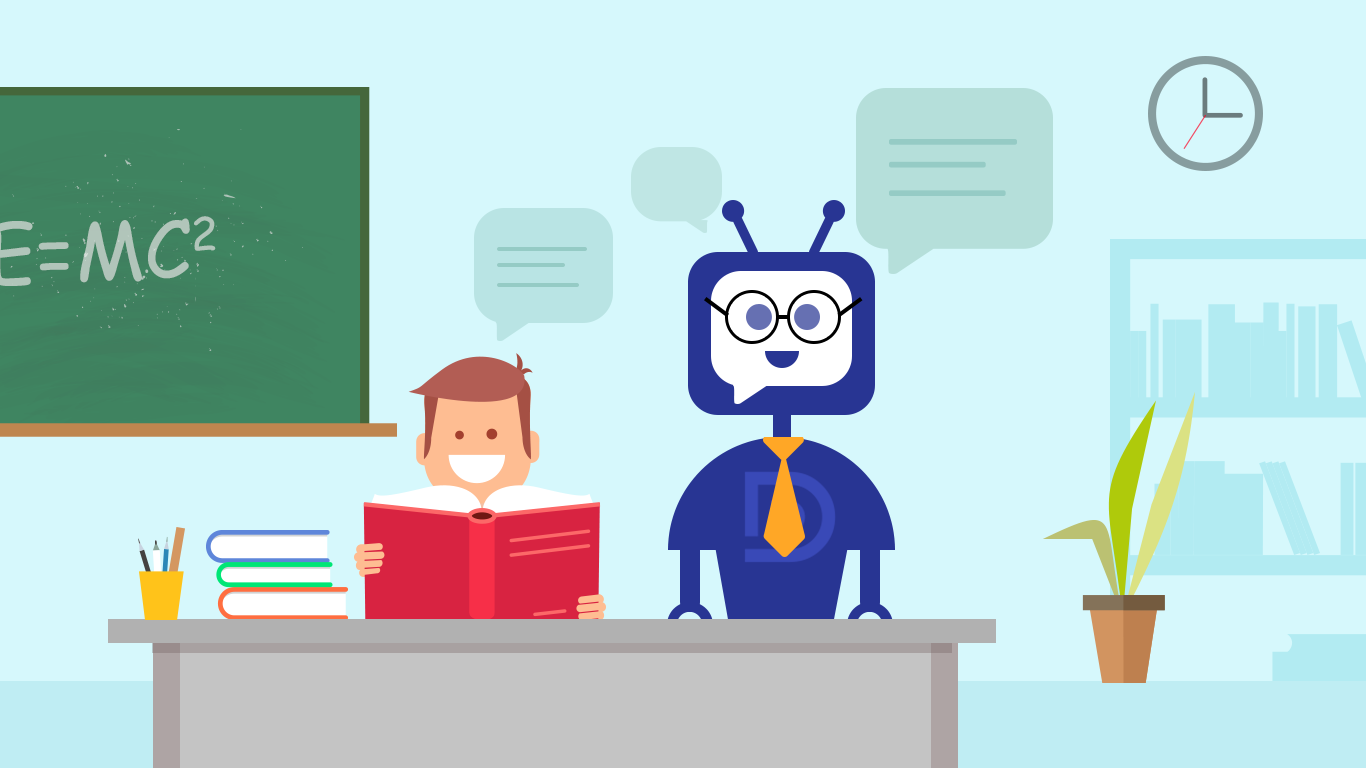
Walk into any forward-thinking classroom today and you may notice something that would have seemed like science fiction just a decade ago: students and teachers routinely conversing with artificial intelligence. Not typing keywords into a search engine, not clicking through a menu-driven help system, but engaging in natural, fluid dialogue with AI assistants that understand questions, explain concepts, provide feedback, generate materials, and support learning in ways that are reshaping education from the ground up. AI chatbots — conversational AI systems capable of understanding and generating human language — have emerged as one of the most versatile, accessible, and immediately impactful technologies in modern education. Their role is expanding rapidly, and understanding what they do, how they work, and what they mean for the future of teaching and learning has become essential knowledge for everyone involved in education.
What Are AI Chatbots in Education?
AI chatbots in education are conversational software systems powered by natural language processing (NLP) and large language models (LLMs) that interact with students, teachers, and administrators through text or voice dialogue. Unlike the rigid, keyword-triggered chatbots of earlier technology generations — which could only respond to a narrow set of predetermined inputs — modern AI educational chatbots understand context, maintain conversational continuity across multiple exchanges, interpret nuanced questions, and generate contextually appropriate, substantively useful responses.
The technological leap that brought AI chatbots from novelty to genuine educational utility was the emergence of transformer-based large language models — the architecture underlying systems like ChatGPT, Claude, Gemini, and their educational derivatives. These models, trained on vast corpora of human-generated text, developed the ability to engage in open-ended dialogue across virtually any subject with a fluency and depth that previous AI systems could not approach. When applied to educational contexts — with appropriate pedagogical design, content guardrails, and institutional integration — these capabilities translate into tools of remarkable instructional and administrative value.
How AI Chatbots Support Student Learning
The most direct and immediately impactful role of AI chatbots in education is as on-demand learning support for students — available 24 hours a day, seven days a week, in any subject, at any level of complexity, without judgment, impatience, or the social anxiety that many students feel when asking questions in front of peers.
Concept explanation and tutoring is the most foundational student-facing function. A student struggling with a calculus concept at 11 PM the night before an exam no longer has to wait until the next day to get help. An AI chatbot can explain the concept in multiple ways, provide worked examples at appropriate difficulty levels, answer follow-up questions, and identify the specific point of confusion — all in natural conversational language that adapts to the student’s responses. For students in under-resourced schools without access to after-school tutoring programs, this availability is transformative.
Writing support and feedback represents another high-value application. AI chatbots can review student writing drafts and provide specific, actionable feedback on argument structure, evidence use, clarity, grammar, and stylistic quality — feedback that previously required a teacher’s time and attention and was therefore available to students at most a few times per semester. With AI chatbot feedback available instantly after every draft, students can engage in the iterative revision process that research identifies as the most effective path to writing improvement. Crucially, the most educationally sound implementations provide feedback without rewriting the student’s work — preserving the learning value of the writing process while supporting improvement.
Study support and exam preparation are additional high-use applications. AI chatbots can generate practice questions, create study guides from uploaded course materials, quiz students through adaptive flashcard sessions, explain incorrect answers in detail, and help students identify the knowledge gaps in their exam preparation. The conversational format makes study sessions more engaging and interactive than traditional self-study methods, and the AI’s patience with repetitive questions removes the social friction that sometimes prevents students from seeking the repeated explanation or practice they need.
Language learning and practice may be the domain where AI chatbots provide the most uniquely valuable student support. Language acquisition requires extensive conversational practice — but most students have access to conversation practice only during class time, which is woefully insufficient for developing genuine fluency. AI chatbots provide unlimited, judgment-free conversation practice in the target language, correcting errors in real time, introducing new vocabulary contextually, and adapting the complexity of their language to the learner’s current level. For students learning English as a second language or studying foreign languages without access to native speaker communities, this conversational practice opportunity is genuinely game-changing.
Pedagogical Design: The Socratic Difference
The educational effectiveness of AI chatbots depends critically on their pedagogical design — particularly the distinction between chatbots that provide answers and those that guide students toward generating answers themselves. This distinction, rooted in centuries of educational philosophy and decades of learning science research, determines whether AI chatbots build genuine understanding or merely create dependency.
The Socratic method — responding to questions with questions that lead the student through a reasoning process toward their own discovery of the answer — is the gold standard of tutorial dialogue. When a student asks “What is the answer to this equation?”, a Socratically designed AI chatbot responds with “What operation do you think should be applied to isolate the variable on the left side?” This approach requires more persistence from the student, but produces understanding that is far more durable and transferable than passively receiving an answer.
Khan Academy’s Khanmigo chatbot is explicitly designed around this Socratic principle. It is programmed to avoid giving direct answers to homework questions, instead guiding students through the reasoning process with probing questions. This design reflects a sophisticated understanding of the difference between the experience of understanding and the experience of being told — and a commitment to ensuring that AI assistance builds rather than bypasses genuine learning.
How AI Chatbots Support Teachers
While student-facing applications attract the most public attention, AI chatbots are equally transforming the professional lives of teachers by automating routine tasks, supporting lesson development, and enabling more responsive communication with students and families.
Lesson planning and curriculum development is one of the highest-value teacher-facing applications. Generating a well-structured lesson plan aligned to specific learning standards, differentiating materials for different learner levels, creating engaging discussion questions, and developing rubrics for complex assignments are all time-intensive tasks that AI chatbots can accomplish in minutes. A teacher can describe their learning objectives, student population, and available time to an AI assistant and receive a complete, contextually appropriate lesson plan that they can review, modify, and implement — reducing preparation time by hours per week.
Assessment and grading support allows teachers to delegate repetitive grading tasks while maintaining professional oversight of evaluation. AI chatbots can evaluate multiple-choice and short-answer assessments automatically, apply teacher-defined rubrics to written responses, provide initial feedback drafts on essays that teachers review and personalize, and generate detailed progress reports synthesizing each student’s performance data — administrative work that previously consumed enormous quantities of teachers’ time outside the classroom.
Parent and student communication is another domain where AI chatbots provide significant practical relief. Drafting personalized parent communication about student progress, responding to routine student inquiries about deadlines and course requirements, and generating FAQ responses for common questions can all be handled through AI assistance — freeing teachers to focus their direct communication capacity on the conversations that require genuine human relationship and judgment.
Professional development and content knowledge support gives teachers access to an always-available subject matter resource. A primary school teacher asked a question outside their subject expertise can consult an AI chatbot for a clear, accurate explanation that they can then relay to students. A teacher preparing to introduce an unfamiliar historical topic can use AI dialogue to rapidly build background knowledge. This democratization of subject matter expertise is particularly valuable for teachers in under-resourced schools who lack specialist colleagues to consult.
Real-World Implementations Across Education
The deployment of AI chatbots in education has accelerated dramatically, with examples spanning every level and context of learning.
Arizona State University has been among the higher education institutions most aggressive in AI chatbot adoption, deploying AI assistants integrated with its learning management system to answer student questions about course requirements, provide academic support, and guide students through administrative processes — with measurable improvements in student satisfaction and first-year retention rates.
Duolingo’s AI chatbot features enable language learners to practice conversation with an AI partner that roleplays real-world scenarios — ordering food in a restaurant, checking in at a hotel, navigating a business meeting — adapting the language complexity to each learner’s level and providing immediate correction of errors. This scenario-based conversational practice addresses the most commonly cited gap in language learning apps: the transition from structured exercises to genuine communicative use.
Georgia State University’s AI advising chatbot, Pounce, has responded to hundreds of thousands of student inquiries about financial aid, registration, housing, and academic requirements — dramatically reducing the administrative burden on human advisors while providing students with immediate, accurate responses to questions that would otherwise go unanswered or require days of waiting. Studies of Pounce’s deployment documented significant reductions in summer melt — the phenomenon of admitted students who fail to enroll due to administrative confusion or unanswered questions.
In K-12 settings, platforms like Khanmigo, Socratic by Google, and Brainly’s AI have been widely adopted as homework support tools — providing students with explanations, worked examples, and step-by-step guidance that helps them complete assignments with understanding rather than simply copying solutions.
Academic Integrity in the Age of AI Chatbots
No discussion of AI chatbots in education can responsibly avoid the profound challenge they pose to academic integrity. Generative AI systems capable of producing well-structured essays, solving complex mathematical problems, writing functional code, and answering examination questions in seconds have fundamentally disrupted the assumptions on which traditional academic assessment rests.
The institutional response to this challenge has evolved significantly from the initial panic-driven bans that characterized many institutions’ first reactions. Blanket prohibitions proved both technically unenforceable and pedagogically counterproductive — creating a gap between the AI-free classroom and the AI-saturated professional world that students are preparing to enter. AI detection tools have proven unreliable, generating both false positives that wrongly accuse innocent students and false negatives that fail to catch AI-generated work.
The most constructive institutional responses have focused on assessment redesign for the AI era. Oral examinations, process-based portfolios, in-class writing, project-based assessments, and assignments requiring personal reflection and lived experience are all significantly more resilient to AI completion than traditional take-home essays. More fundamentally, progressive educators are redesigning their assessment philosophy entirely — asking not “Did the student produce this output without AI assistance?” but “Does the student demonstrate genuine understanding and the ability to apply knowledge in novel contexts?” — a standard that AI cannot meet on a student’s behalf.
Teaching AI literacy as an explicit component of academic integrity education is equally essential. Students who understand what AI can and cannot do, how to use it appropriately as a tool rather than a replacement for thinking, and what their own intellectual responsibility looks like in an AI-assisted world are better positioned to engage with AI ethically and productively.
Equity, Access, and the Language Dimension
AI chatbots hold significant equity potential — but realizing that potential requires deliberate attention to the barriers that limit access for the students who most need support. Device access, internet connectivity, and digital literacy remain fundamental prerequisites that many students in developing countries and under-resourced communities lack.
The language dimension of AI chatbot equity deserves particular attention. The majority of high-capability educational AI chatbots are optimized for English, with significantly degraded performance in other languages. For the billions of students worldwide whose primary language is not English — including the 500 million Spanish speakers in Latin America, the hundreds of millions of Arabic speakers across the Middle East and North Africa, and the vast linguistic diversity of sub-Saharan Africa and Southeast Asia — language-limited AI educational tools fail to deliver their equity promise.
Multilingual AI development is advancing rapidly, and several platforms are making significant investments in Spanish, Portuguese, French, Arabic, Mandarin, and other major world languages. But the development of high-quality educational AI support for lower-resource languages remains a critical unmet need — one whose solution will determine whether AI chatbots become a universal educational resource or another technology that primarily benefits those already well-served.
The Human Heart of Education
Every consideration of AI chatbots in education must return to a foundational truth: education is not, at its core, a transaction of information. It is a human relationship — between teacher and student, between learner and knowledge, between individual and community — animated by curiosity, care, inspiration, and the irreplaceable experience of being genuinely known and understood by another person.
AI chatbots can explain, inform, practice, assess, and support with impressive capability. They cannot inspire. They cannot model intellectual passion. They cannot recognize the distress behind a student’s flat affect, or know that a student’s declining engagement reflects a family crisis rather than academic disengagement, or provide the moment of genuine human connection that transforms a reluctant learner into a committed one. These capacities belong exclusively to human teachers, and they represent the irreducible core of what education is for.
The appropriate role of AI chatbots in education is therefore one of augmentation and liberation — handling the routine, the repetitive, and the logistically complex so that human educators can be more fully present for the human work that only they can do. When AI chatbots free teachers from hours of administrative labor and enable them to invest more deeply in relationships, discussion, and the cultivation of genuine understanding, they are fulfilling their highest educational purpose.
The future of AI chatbots in education belongs to institutions that approach them with this clarity — leveraging their genuine capabilities without illusion about their limitations, and always keeping the full humanity of every learner at the center of every technological decision.